Over the last year, at the office, we have probably generated thousands of AI images.
As someone who runs a creative agency, embracing AI wasn’t optional—it was necessary. Today, it’s an integral part of how we work. It helps us move faster, explore more directions, and sometimes even solve creative roadblocks that would have taken hours before.
But somewhere along the way, I also started noticing something else.
Scroll through your social media feed today, and after a while, almost every AI-generated visual begins to look… familiar.
The colour palettes.
The lighting.
The facial expressions.
The compositions.
The dramatic camera angles.
Even when the prompts are different, the visual language starts feeling the same.
Ironically, a technology capable of producing infinite possibilities is slowly creating a certain sameness.
And that’s where I believe the conversation changes.
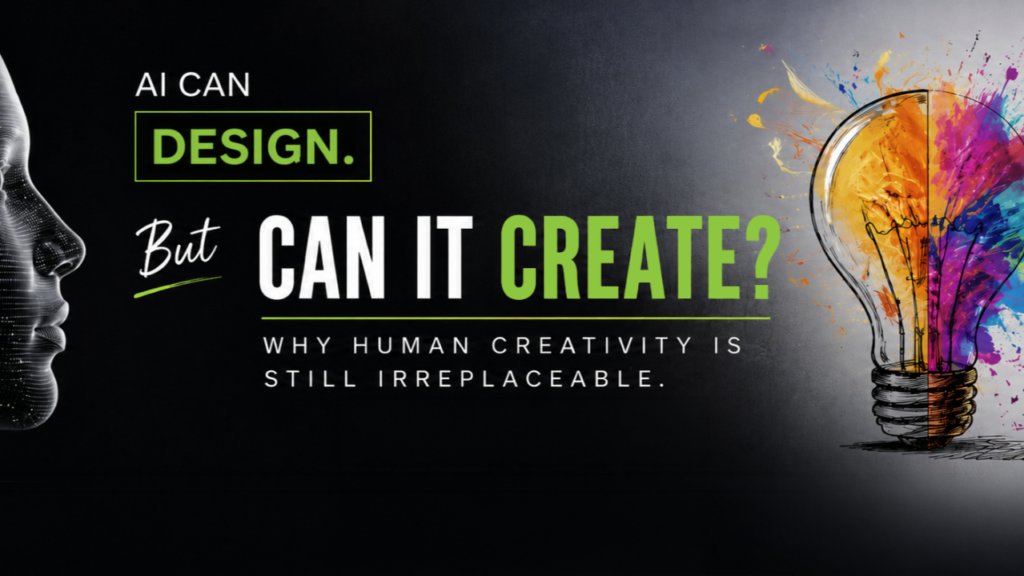
AI can generate design. But creativity is something entirely different.
One of the biggest misconceptions today is that if you can describe an idea, AI will create it.
It will. But it will create what it has already learnt. It works on patterns, probabilities, references, and everything it has seen before.
Great designers don’t.
The best creative work has never been about showing people what already exists. It has always been about making them see something they never imagined before.
The campaigns we still remember years later weren’t celebrated because they were beautifully designed. They were celebrated because someone looked at an ordinary problem from an extraordinary perspective.
They connected two ideas no one else had connected. They saw the unseen. That’s not something a prompt can do on its own.
AI doesn’t wake up wondering, “What if we looked at this differently?”
A creative mind does.
Another myth I often hear is that AI will replace designers. My answer is always the same.
AI won’t replace designers. Designers using AI will replace designers who don’t.
Because even the best AI tools are only as good as the person operating them. Knowing which tool to use. Understanding composition. Recognising what feels authentic and what feels manufactured. Writing prompts that communicate intent instead of instructions. Curating from hundreds of outputs instead of accepting the first one.
All of this still requires experience, taste, and judgment.
While tool has become more powerful. The human behind it has become even more important.
Perhaps the biggest misunderstanding of all is confusing design with creativity.
Design is execution.
Creativity is imagination.
One can be automated.
The other is deeply human.
Creativity is shaped by emotion.
By culture.
By lived experiences.
By failures.
By conversations.
By travel.
By books.
By curiosity.
By observing life when no one else is looking.
No machine has lived a life.
It has only processed ours.
Will AI continue to transform design?
Absolutely.
Will it redefine workflows?
Without question.
Will it eliminate repetitive production work?
It already has.
But the day a machine experiences heartbreak, nostalgia, humour, empathy, or the irrational leap of imagination that gives birth to an unforgettable campaign…
…that’s the day I’ll begin to worry.
Until then, I remain convinced that the future of design doesn’t belong to AI.
It belongs to people who know how to combine technology with imagination.
Because tools evolve.
Human creativity does too.